


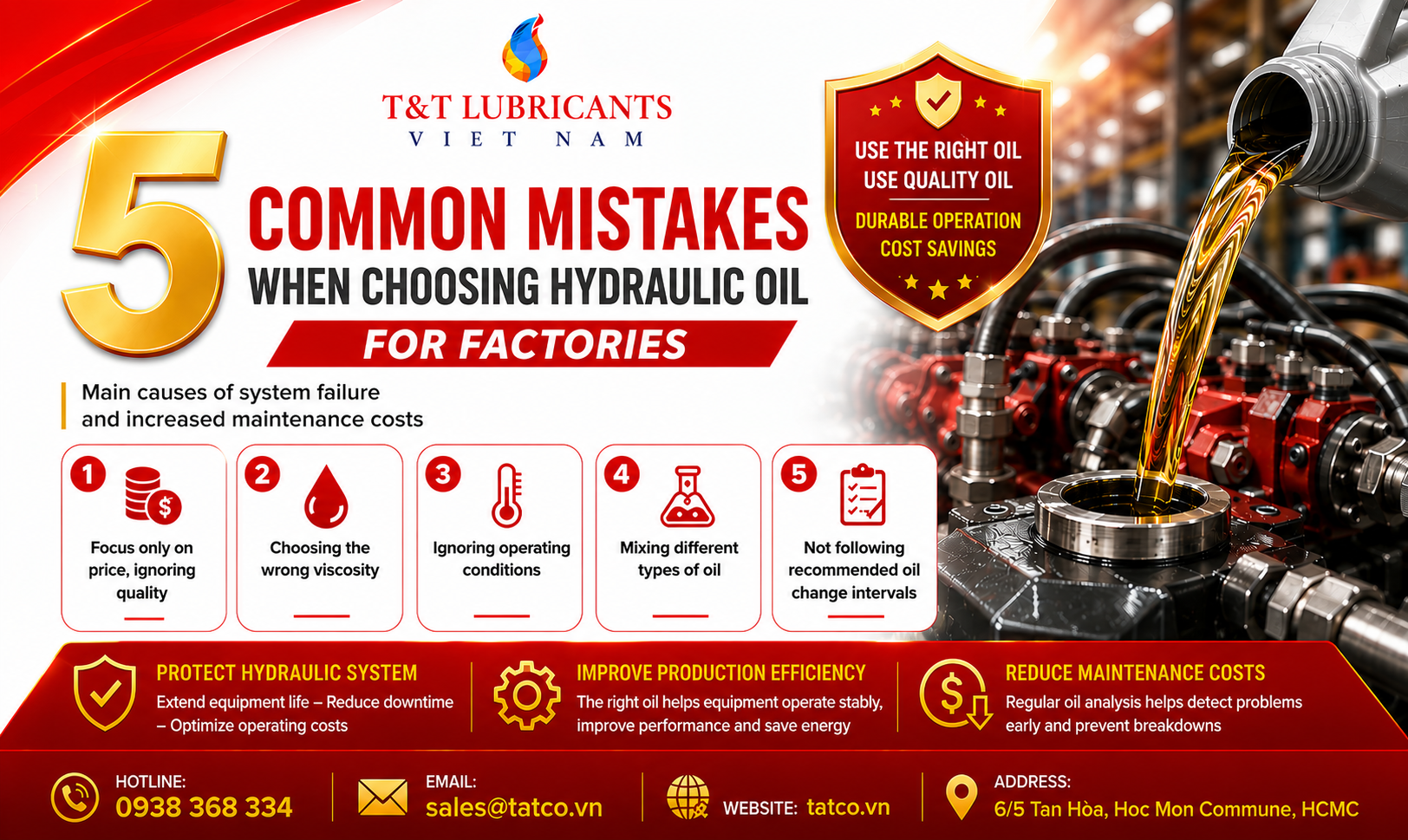
5 COMMON MISTAKES WHEN CHOOSING HYDRAULIC OIL FOR FACTORIES – CAUSES OF HIGHER OPERATING COSTS AND REDUCED EQUIPMENT LIFE
In modern manufacturing facilities, hydraulic systems play a critical role in powering presses, molding machines, CNC equipment, automated production lines, and many other industrial machines.
However, many companies invest heavily in equipment while paying insufficient attention to selecting the right hydraulic oil. This can lead to accelerated pump wear, sticking control valves, system overheating, reduced efficiency, and increased maintenance costs.
Hydraulic oil is more than just a power transmission medium. It is also responsible for lubrication, cooling, wear protection, oxidation resistance, and the overall protection of the hydraulic system.
Below are five common mistakes many factories make when selecting hydraulic oil.
1. Prioritizing Purchase Price Over Overall Operating Performance
One of the most common mistakes is evaluating hydraulic oil primarily based on its initial purchase price.
In reality, lubricant costs typically represent only a small portion of the total operating cost of a hydraulic system. Meanwhile, costs associated with downtime, equipment repairs, component replacement, maintenance labor, and production losses are often significantly higher.
Low-quality hydraulic oils may have:
- Limited oxidation resistance.
- Short service life.
- Reduced anti-wear performance.
- Increased sludge and varnish formation.
- Poor water separation capability.
Consequences
❌ Accelerated hydraulic pump wear.
❌ Increased risk of control valve sticking.
❌ Frequent filter blockage.
❌ Reduced system efficiency.
❌ Higher maintenance and repair costs.
➡️ When evaluating hydraulic oil, companies should consider the Total Cost of Ownership (TCO) rather than focusing solely on the initial purchase price.
2. Selecting the Wrong Hydraulic Oil Viscosity
Viscosity is one of the most important properties affecting lubrication performance and hydraulic system efficiency.
Common Viscosity Grades
Viscosity Grade | Typical Application |
ISO VG 32 | Low-temperature environments and precision hydraulic systems |
ISO VG 46 | General manufacturing facilities |
ISO VG 68 | High-load applications or high-temperature environments |
Consequences of Using Oil That Is Too Viscous
- Difficult startup.
- Increased energy consumption.
- Higher operating temperatures.
- Reduced pump efficiency.
Consequences of Using Oil That Is Too Thin
- Reduced lubrication performance.
- Loss of system pressure.
- Increased wear.
- Shortened equipment life.
➡️ Always select the viscosity grade recommended by the equipment manufacturer or consult a qualified lubrication specialist.
3. Failing to Evaluate Actual Operating Conditions
Every manufacturing facility operates under different environmental and operating conditions, which directly affect lubricant life.
Key factors to consider include:
- High ambient temperatures.
- High humidity.
- Dust contamination.
- Continuous 24/7 operation.
- Frequently changing loads.
Using standard hydraulic oil in severe operating conditions can accelerate oil degradation and reduce equipment protection.
Hydraulic Oil for Severe Operating Conditions Should Provide
✅ High Viscosity Index (VI).
✅ Excellent oxidation resistance.
✅ Effective anti-wear (AW) protection.
✅ Strong water separation capability.
✅ Excellent foam control performance.
➡️ Selecting the right oil helps extend oil drain intervals, improve system reliability, and reduce operating costs.
4. Mixing Different Hydraulic Oils
This is a common mistake when companies change lubricant suppliers or top up oil during operation.
Not all hydraulic oils are compatible with one another.
Mixing oils from different brands or additive technologies may cause:
- Additive precipitation.
- Foam formation.
- Reduced anti-wear protection.
- Poor water separation.
- Accelerated oxidation.
Consequences
❌ Unstable system performance.
❌ Filter blockage.
❌ Control valve sticking.
❌ Reduced oil service life.
❌ Increased risk of equipment failure.
➡️ Before changing lubricants, a proper Oil Conversion procedure should be carried out to ensure compatibility and maintain system performance.
5. Neglecting Routine Oil Analysis
Many companies only replace hydraulic oil when it becomes discolored or when equipment problems occur.
This reactive maintenance approach can expose operations to unnecessary risks.
Key Parameters to Monitor
- Viscosity.
- Water content.
- Acid Number (TAN).
- Contamination level.
- Wear metal content.
- Oxidation level.
Benefits of Oil Analysis
✅ Early detection of potential equipment problems.
✅ Reduced downtime.
✅ Extended oil service life.
✅ Longer equipment life.
✅ Optimized maintenance planning.
➡️ Routine oil analysis is one of the most effective tools in a Predictive Maintenance program.
6. Warning Signs That Your Factory May Be Using the Wrong Hydraulic Oil
If your hydraulic system exhibits any of the following symptoms, it may be time to review your lubricant selection:
- Abnormally high oil temperatures.
- Excessive pump noise.
- Reduced cylinder speed.
- Slow valve response.
- Rapid filter contamination.
- Burnt oil odor.
- Frequent pressure-related alarms.
These are early warning signs that can help prevent more serious equipment failures.
7. Frequently Asked Questions (FAQ)
Is ISO VG 46 the most commonly used hydraulic oil?
Yes. ISO VG 46 is the most widely used viscosity grade in general manufacturing facilities.
Can hydraulic oils from different brands be mixed?
This is generally not recommended. Mixing oils can destabilize additive systems and negatively affect performance.
How often should hydraulic oil be replaced?
The replacement interval depends on operating conditions and oil analysis results. Routine oil analysis is the most effective method for determining the optimal oil change interval.
Is oil analysis really necessary?
Yes. Oil analysis is a valuable tool for identifying potential equipment issues early and optimizing maintenance costs.
8. Conclusion
Selecting the right hydraulic oil is one of the most important factors in improving equipment reliability, optimizing operating costs, and extending system life.
The right hydraulic oil can help:
✅ Extend hydraulic pump life.
✅ Protect valves and cylinders.
✅ Reduce unplanned downtime.
✅ Improve production efficiency.
✅ Lower maintenance costs.
✅ Optimize Total Cost of Ownership (TCO).
9. Contact T&T for Professional Support
If your company requires assistance with hydraulic oil selection, lubricant conversion, oil analysis, or the implementation of a comprehensive lubrication management program, T&T’s technical team is ready to help.
🏢 T&T Vietnam Lubricants Co., Ltd.
📞 HOTLINE: 0938.368.334
📍 ADDRESS: 6/5 Tan Hoa, Hoc Mon Commune, Ho Chi Minh City, Vietnam
📧 EMAIL: sales@tatco.vn
🌐 WEBSITE: tatco.vn