


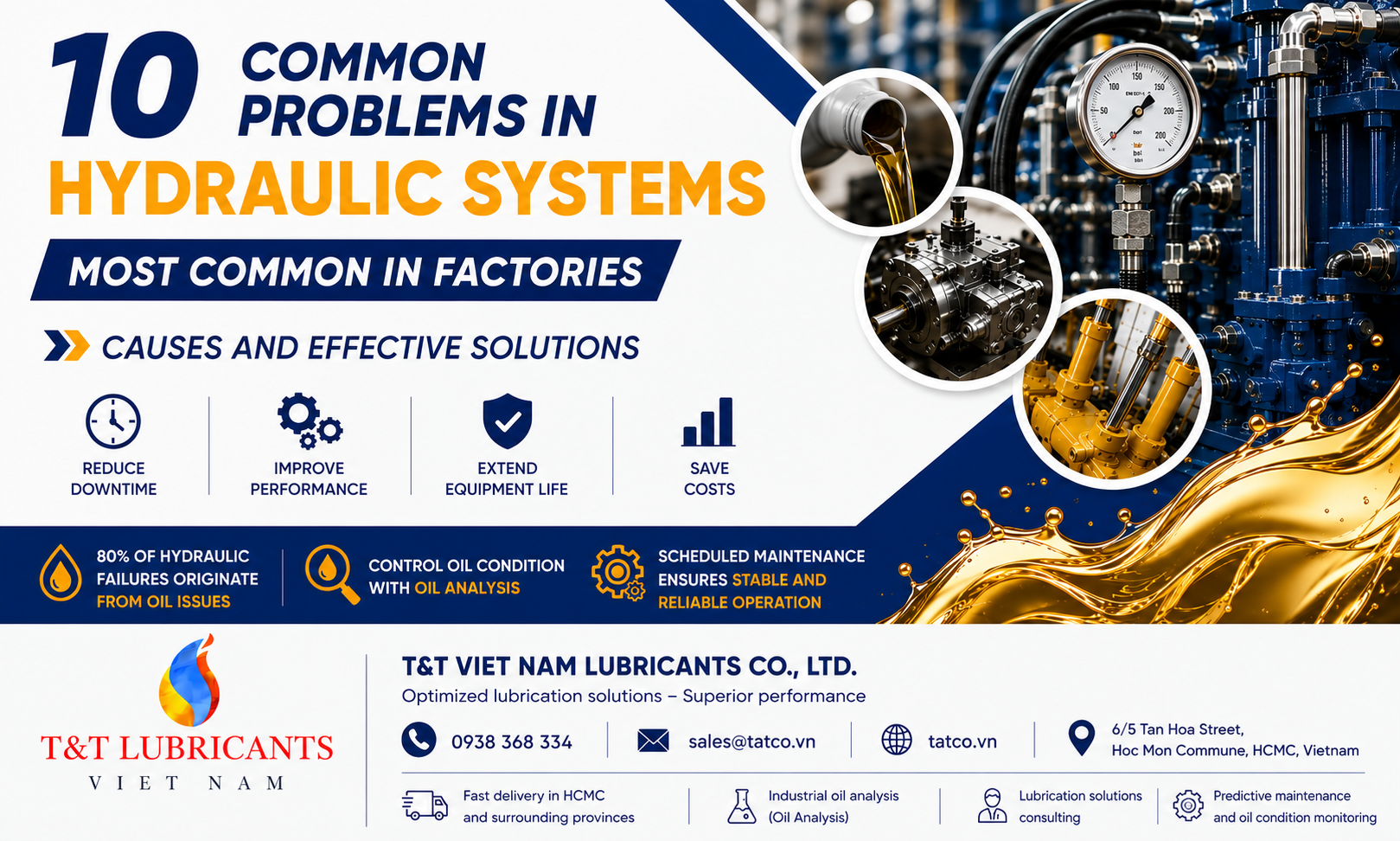
10 COMMON HYDRAULIC SYSTEM PROBLEMS – CAUSES AND EFFECTIVE SOLUTIONS
Hydraulic systems play a critical role in industries such as steel, cement, plastics, mining, ports, and manufacturing. They provide the force and motion control required for hydraulic presses, injection molding machines, rolling mills, lifting equipment, and many other industrial applications.
However, hydraulic systems are exposed to various operating conditions that can lead to unexpected failures, reduced productivity, and costly downtime. According to practical experience in industrial plants, most hydraulic failures are directly or indirectly related to oil condition and maintenance practices.
Below are the 10 most common hydraulic system problems, their causes, and effective solutions.
1. Low Power or Weak Hydraulic Performance
Causes
- Insufficient hydraulic oil level.
- Worn hydraulic pump.
- Incorrect pressure setting of the relief valve.
- Internal leakage in cylinders or control valves.
Solutions
- ✅ Check oil level.
- ✅ Measure system pressure.
- ✅ Inspect pump wear.
- ✅ Check for internal leakage.
Practical example: In steel mill hydraulic presses, a pressure drop of only 10–15% can significantly reduce pressing force and affect product quality.
2. Excessive Hydraulic Oil Temperature
Causes
- Incorrect oil viscosity.
- Inefficient oil cooler.
- Excessive operating load.
- Low oil level.
Solutions
- ✅ Verify oil viscosity grade.
- ✅ Clean the heat exchanger or cooler.
- ✅ Check actual operating load.
- ✅ Refill with the correct hydraulic oil.
Note: Continuous operation above 60°C accelerates oil oxidation and shortens the life of pumps and hydraulic components.
3. Hydraulic Pump Produces Excessive Noise
Causes
- Air entering the suction line.
- Clogged suction filter.
- Low oil level.
- Cavitation.
Solutions
- ✅ Inspect suction piping.
- ✅ Replace or clean filters.
- ✅ Check seals and fittings.
- ✅ Refill hydraulic oil.
Warning sign: Abnormal knocking or whining noises often indicate cavitation and should be addressed immediately.
4. Foaming Hydraulic Oil
Causes
- Air contamination.
- Poor oil quality.
- Low oil level.
- Water contamination.
Solutions
- ✅ Locate air ingress points.
- ✅ Bleed air from the system.
- ✅ Inspect oil condition.
- ✅ Replace oil if necessary.
Impact: Foam reduces hydraulic efficiency and increases the risk of cavitation and component wear.
5. Jerky Cylinder Movement
Causes
- Air trapped in the oil.
- Sticking control valves.
- Unstable pump flow.
Solutions
- ✅ Remove air from the system.
- ✅ Clean or replace valves.
- ✅ Inspect pump performance.
Application example: In plastic injection molding machines, jerky movement can directly affect product quality.
6. Cylinder Drift or Load Drop
Causes
- Damaged cylinder seals.
- Leaking load-holding valves.
- Worn control valves.
Solutions
- ✅ Replace cylinder seals.
- ✅ Inspect lock valves.
- ✅ Overhaul or replace control valves.
- Risk: Load drift may create safety hazards and damage lifting equipment.
7. Excessive Hydraulic System Vibration
Causes
- Cavitation.
- Air in oil.
- Improper piping installation.
- Pressure fluctuations.
Solutions
- ✅ Check suction conditions.
- ✅ Monitor system pressure.
- ✅ Reinforce piping supports.
- ✅ Eliminate vibration sources.
- Note: Prolonged vibration can shorten the life of pumps, valves, and pipelines.
8. Hydraulic Valves Frequently Stick
Causes
- Contaminated oil.
- Varnish deposits.
- Dirty or clogged filters.
Solutions
- ✅ Perform regular oil analysis.
- ✅ Replace filters on schedule.
- ✅ Flush the system when necessary.
Real-world experience: Many servo and proportional valve failures are caused by varnish formation rather than mechanical defects.
9. Hydraulic Filters Plug Too Quickly
Causes
- Oil oxidation.
- External contamination.
- Internal debris generation.
Solutions
- ✅ Analyze oil condition.
- ✅ Identify contamination sources.
- ✅ Replace degraded oil.
Warning sign: Rapid filter blockage often indicates serious contamination problems within the system.
10. Premature Hydraulic Pump Failure
Causes
- Water contamination.
- Solid particle contamination.
- Incorrect oil viscosity.
- Lack of regular filter replacement.
Solutions
- ✅ Maintain oil cleanliness.
- ✅ Monitor oil condition through Oil Analysis.
- ✅ Implement predictive maintenance programs.
- ✅ Replace filters according to schedule.
Industry statistics: More than 70% of hydraulic pump failures are related to oil condition.
80% OF HYDRAULIC FAILURES ORIGINATE FROM OIL
Based on practical experience in steel plants, cement plants, plastics manufacturing, and mechanical industries, the most common causes of hydraulic failures are:
- Water contamination.
- Dirt and particle contamination.
- Oil oxidation.
- Incorrect oil viscosity.
These issues can result in pump wear, valve sticking, excessive heat generation, and unplanned downtime.
Routine Oil Analysis is one of the most effective ways to detect potential problems early and maximize equipment reliability.
WEEKLY HYDRAULIC SYSTEM CHECKLIST
- ☐ Check oil level.
- ☐ Monitor operating temperature.
- ☐ Measure system pressure.
- ☐ Listen for abnormal pump noise.
- ☐ Inspect filter condition.
- ☐ Check for foaming.
- ☐ Inspect oil leaks.
- ☐ Observe oil color and odor.
- ☐ Review oil analysis reports.
- Regular inspections help identify abnormalities before major failures occur.
CONCLUSION
Most hydraulic system failures show warning signs long before a catastrophic breakdown occurs. Monitoring oil condition, maintaining system cleanliness, replacing filters on schedule, and implementing preventive maintenance programs can significantly extend equipment life and reduce maintenance costs.
For modern industrial facilities, hydraulic oil management is not merely maintenance—it is a key strategy for maximizing productivity and minimizing downtime.
🏢 T&T Vietnam Lubricants Co., Ltd.
📞 HOTLINE: 0938.368.334
📍 ADDRESS: 6/5 Tan Hoa, Hoc Mon Commune, Ho Chi Minh City, Vietnam
📧 EMAIL: sales@tatco.vn
🌐 WEBSITE: tatco.vn